Neil Matthews

Author: Neil Matthews

  • Things To Consider When Hiring WordPress Technical Support

    Things To Consider When Hiring WordPress Technical Support

    You may not have hired someone to perform technical support work on your WordPress site before.  This post is designed to give you a feel for what you should consider when selecting WordPress help.

    Why Hire Technical Support?

    You may be able to struggle through and fix your own issues, but brining in technical support for the more complex tasks on your site can save you a lot of time and effort, time which can be better spent on your core business or blogging activities.

    I could probably do many of the jobs a plumber can do, but the plumber has the years of experience, an eye for where problems may occur and all of the correct tools for the job.  They will do it faster, better and more efficiently than I could.  This is why you should consider bringing on technical support for your WordPress project.

    Type Of Tasks To Outsource

    I would say that 80% of the day to day tasks required to look after a WordPress site can be performed by people with little or no technical skills.  WordPress was designed that way.  People write plugins and develop themes to remove that layer of complexity, there is however a final 20% that requires an understanding of the core technologies behind WordPress; php, css and mysql, these can include:

    • Tweaking theme code
    • Integrating plugins and themes
    • Fixing hacked sites
    • Building new sites
    • Fixing crashed sites
    • Optimising and fixing database issues

    These are the types of tasks people don’t have the skills or inclination to attempt.

    Assessing Your Potential Contractor

    The rest of this post is all about the types of things you should be asking of your potential WordPress contractor.

    Translate Your Request Into A Technical Project

    Will your contractor translate your requirements into a viable project or will they take you at your word and do exactly what you ask rather than what is best for your site?  You are probably not a WordPress “techie” if you are hiring contractors to fix your issues, you want someone who can take your request and translate that into what is really required to fix your site.

    This is done through experience of WordPress, an ability to translate a request to a technical specification and a desire to be open and honest.  If there is a free plugin to solve a problem tell the client that rather than attempt to sell your services to write some custom code.  I often loose projects by telling potential clients that there is a quick fix, but people appreciate this and the I’m pretty sure I will hear from them again in the future.

    Backup & Recovery Plans

    Will your contractor backup your site and have a recovery plan before they even start on your project.  Even the best techies sometimes break sites by accident when performing complex technical work, make sure they put in place a backup and recovery plan before they begin work.

    Testimonials & Client Track Record

    The barrier for entry into the technical support world is not high, WordPress is free the ability to learn and become proficient is realtively easy.  Check that your potential contactor has testimonials from real live projects they have worked on.  Do they have a track record of treating their clients well, do they fix sites on time and to budget?  Are they personable and professional or are they nerds speaking gibberish who cannnot express what needs to be done without resorting to jargon.

    Go for seasoned professionals every time.

    Fixed Bid

    Try to work with someone who will give you a fixed bid for your work, rather than someone working by the hour.  Those hours will very quickly mount up and you will find yourself with an unexpectedly large bill.

    Guaranteed Work

    Does their technical work come with a guarantee or warranty?  Many people work on a by the hour basis, so every hour spent on your site is another hour billed, even if it is time spent fixing issues they have created or not fixed with the first pass.

    Payment Upon Satisfaction Rather Than Completion

    Do you have to pay up front or are payment terms upon completion.  This is a big deal for me, I only bill once my clients are satisfied, I have seen numerous clients coming to me after someone has taken their cash done half the job and disappeared into the internet ether.  There is very little recourse for someone hiring people over the net, I like to bridge this trust gap by not invoicing until they have signed off the project.

    Post Project Support

    Will your contractor give you post project support?  Will they answer your emails about the work they have done, will the log back in and make a few five minute tweaks?  I hate to see people who are billed for even the most trivial piece of work, I want to build long term relationships with my clients not suck them dry of cash.

    Hire Me and My Team

    This is of course how my team and I work, check out the video on my services pages on how me and my team conduct our business, so if you are in need of technical support for your site why not request a fixed bid no obligation quote.


  • Paul Dixon – Macsessed.com

    Although I have used WordPress to build a number of websites in the past, I recently discovered a problem where the layout of one of my latest projects was breaking when viewed in Firefox. After spending a frustrating afternoon trying to resolve the issue myself and getting nowhere, I decided to contact Neil. Besides fixing the problem promptly, he was a pleasure to work with. I would happily recommend Neil to anyone who needs some help with their site, and I am sure I will be using his services again in the future.

    Paul Dixon – www.macsessed.com

  • Elsewhere in My Digital Empire

    Elsewhere in My Digital Empire

    I’ve been out and about creating other content on other properties not just WPDude.com, here is a list of some other stuff you may like to read.

    Guest Post At Problogger.net

    I was lucky enough to score some guest posting slots over at Darren Rowse’ Problogger.net site.  I wrote

    How to trouble shoot WordPress

    Are You Protecting Your Blogs Most Valuable Asset

    Posts at Neil-Matthews.com

    If you are new to my writings at Neil-Matthews.com you may want to check out start here for an overview

    Building A Businesss Not A Job

    Monetisign Your DP With Ads

    Digital Persona Liabilities

    It’s Never Too Early To Start A Digital Legacy

    Knowledge From 1 to 10

    The Asset Snowball Effect

    Are You Building An Evergreen Business

    Image by archana3k1

  • Validating Plugins

    Validating Plugins

    One of the biggest problems with plugins in my opinion, is that they are not certified in any way.  It is hard to tell what is a good plugin, and what will cause you issues.

    The majority of crashed sites I am called upon to fix are caused by plugin problems.  The good news is that there is a community moderation process so you can get other WordPress users’ opinions on particular plugins.

    Only Get Plugins From WordPress.Org

    The community moderation only happens on WordPress.org, and my recommendation is that you only download or install plugins from that site not a plugin authors site.

    If a plugin is not hosted on Wp.org this should raise a red flag in your mind, why are they not submitting their plugin for peer review, is it of poor quality, does it contain malware, legitimate plugins will be on WordPress.org.

    The exception to this are premium plugins, they will generally not make their plugins freely available on WordPress.org

    The Moderation System

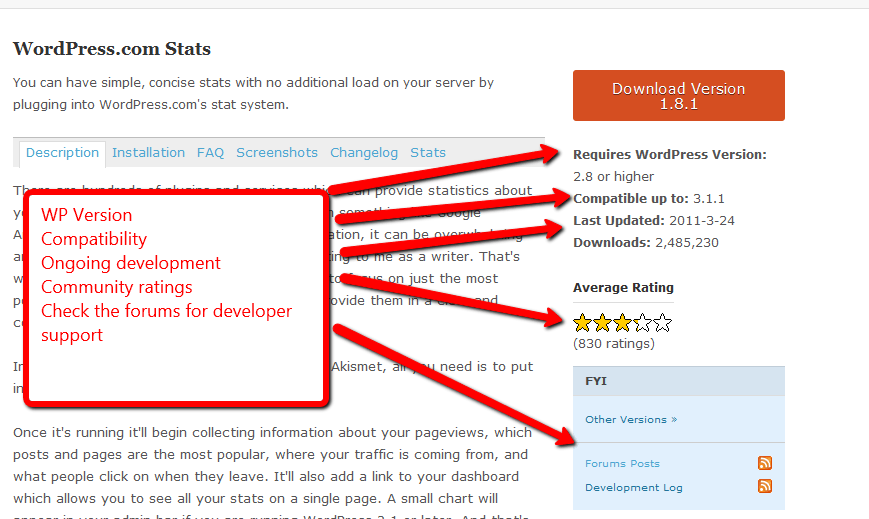
    On WordPress.org next to each plugin held in wordpress.org/extend/plugins you will see the moderation system,see the screen dump below to see how you can check on a plugins quality.


    Click to see full size image


    WordPress Version

    YOu can check to see if the plugin you are about to use is compatible with your current version of WordPress.  This is a good indicator of the on-going development of the plugin.  If the author is not keeping their plugin in line with new releases of WordPress this could be an issue.

    Around about WordPress 2.5 there was a fundamental change in the core WordPress files and I saw many plugins fail because their authors did not keep their plugins in line with WordPress releases.

    Last Updated

    If a plugin is not being actively developed and frequent updates uploaded to WordPress.org (be it bug fixes or new functionality).

    A plugin more than 12 months without an update should make you cautious.

    Number Of Downloads

    High quality plugins are downloaded more frequently as word of mouth marketing gets out about a plugin and more people opt to use  it.

    Average Rating

    This is the key community indicator in my opinion, this is the average rating of a plugin.  Visitors to WordPress.org leave a rating from 1-5 on the quality of that particular plugin

    On another note, please register and start leaving votes for your favourite and less than favourite plugins so the number of valid votes help to increase the voting population to give more accurate results.

    Forums

    The majority of plugins available to download from wp.org also have their own support forum on wp.org, visit the forum and get a feel for the support available. Ask yourself the following questions

    • Are replies timely
    • Are replies courteous, or are they brusque expecting a certain level of expertise
    • Are problem being fixed or do people come back complaining
    • Are requesting going without a reply/solution
    • Are there a large number of requests

    You can get a good feel for the quality of a plugin and it’s authors suport from teh support area.

    Authors Site Forum

    Sometimes you will see that plugin authors host their own support forums on their own sites, it is well worth this trouble to check this forum too.

    In the case of premium plugins this is crucial, you are paying for support as part of the ourchase price, check that the support is frequent and of good quality, are people waiting a long time for responses?

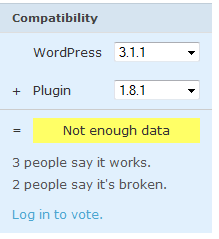
    Compatibility Voting

    A second way wordpres.org visitors can vote on a plugin is to leave a comment if a plugin works or is broken at a particular version.  Check to see if other people are experiencing problems at teh same WP version you are using.

    There is always more than one Solution

    There is always more than one plugin to fix a problem, if you find a plugin and any red flags are raised, move on and find another.

    Installing Over The Net

    If you install your plugins from your WordPress dashboard, you also have access to the modeation system, and you are also assuring your self that you are downloading code from WordPress.org.  If you search and install over the net, please use these processes to check the quality of the plugins you are about to install.

    Plugins Are Free

    Plugins are suppplied as is, and at no cost you should not expect support, but the majority of plugins are well supported by their authors.

    The WP Owners Club

    I have an entire module all about understanding plugins and a video demonstrtation of the concepts I talk about here.  The WP Owners club is my WordPress support and training community, you can get more details including how to join at my WP Owners Club Page.

    Image by andymangold

  • Jacqueline Stewart

    I asked Neil to look at an WordPress security problem that has been bugging me for quite a while and needed some help with.

    I was very impressed with the quick and professional help that I received and would not hesitate to recommend Neil to anyone needing help with their WordPress installation.

    He even pointed out and installed an excellent security plugin that I hadn’t heard of, which I think is great customer service.

    If I need any WordPress help, in the future, I will be contacting Neil again.

    Jacqueline Stewart

  • What Is WordPress Multisite?

    What Is WordPress Multisite?

    Did you know that WordPress has the ability to run multiple websites from one installation of WordPress? This type of configuration is called WordPress Multisite.

    In the past there were two versions of WordPress; standard WP that we all know and love and WordPress MU (Multi User) were distinct downloads.  With the release of WordPress 3.x those two versions were brought together.

    What Is Multisite?

    After a making a couple of configuration changes, you can make your current installation of WordPress manage multiple WordPress sites.  Each site will have it’s own content, users, plugins and themes.

    The benefit is you only have one installation of WordPress to manage and maintain, a brilliant time saver for owners of multiple WordPress sites.

    UPDATE June 2012: Video Tutoral

    Feel free to read the whole blog post, but I’ve created a free video tutorial to show you how to build a multisite installation.

    [leadplayer_vid id=”5051A07EB75E9″]

    Making A Single Site Multisite

    This post is an overview of multi site, so I’m not going to go into the technical details of configuring a network in this post (if there is enough demand I may setup a training session, leave a comment if you would like this type of session).

    There is a very good tutorial over at WordPress.org which will take you through the process.

    http://codex.wordpress.org/Create_A_Network

    Compatibility

    The first thing to consider before moving to MS is the question of compatibility.  Not all themes and plugins will work on Multisite.  Check with your theme and plugin suppliers to see if it is compatible first.  For example my favourite back plugin Backupbuddy it not MS compatible when I last checked,

    A great source of premium WordPress multisite training, plugins and themes is WPMUDEV.org (aff)

    A second compatibility consideration is your hosting.  WordPress MS works in a different way to normal WP, please check with your hosting supplier to see if they support the requirements from http://codex.wordpress.org/Create_A_Network

    More Difficult To Admin

    Administration of WP MS is a little more difficult, there is the concept of a network administrator, who installs and enabled themes, plugins and site wide settings, next level down there is a site admin who can then admin only aspects of their own site.

    This additional layer of administer has caused confusion in me, so be aware of this if you decide to go down this route.

    Easier to manage multiple sites

    This is the main benefit of MS, with one installation of WordPress, you can administer multiple WordPress sites.

    Install a plugin once, and it is available to all sites it you network activate it.

    Update WordPress once, and all of your sites are updated.

    Sub Directories or Subdomains

    When you install MS you get to control how your sites are configured. There are two options sub directories (the easiest method) or subdomains.

    Subdirectories install your sites in the following fashion yourdomain.com/site1 yourdomain.com.site2

    Sub domains create configurations like this site1.yourdomain.com site2.yourdomain.com.

    There are also domain mapping plugins available for MS, which allow you to map a site to an alternative domain, for example you could setup yourdomain.com/site1 to map to the domain name mysecondcomain.com.  This allows you to manage multiple domains from one install of WP.  This is brilliant if you run multiple domains and want to reduce your admin overhead.

    Are You Going Multisite

    Are you going multisite?  Just to recap you need more technical skills to manage a network, some of your plugins may not work, and lastly check out your hosting is compatible. Feel free to ask me any questions on multisite in the comments.

  • The WordPress Work Flow System

    The WordPress Work Flow System

    WordPress has a built in work flow system so you can take a new post (or page) from a draft stage through an editorial process to a final publication status.

    This post will take you through the four work flow stages.

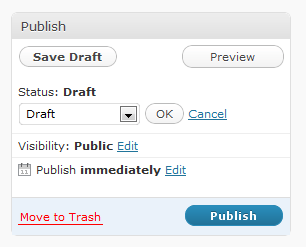
    The Work Flow Tool

    The work flow tool is located in the post or page editor usually on the top of the right hand sidebar. This allows you to set a posts status as we move through the work flow system.

    Draft

    The first status in the work flow system is draft.  When a post or page is marked as draft you are able to work on it, but it does not appear on the front end of your site.

    Think on this as a work in progress.  It is also the default state of a new post or page.

    Pending Review

    The next stage is only applicable to multi author sites.  A contributor role only has permission to write a post and then mark it as pending review (not published).

    A post marked as pending review requires an editor level or above to review that post and move it onto the published state.

    Pending review allows a work flow where multiple contributors to your site create content and pass it to others as an editorial process.

    Published

    Click on the publish button and a post is moved to the state of published.  This means that a post is visible on the front end of your site.

    This is the final stage of work flow and the content is made available to your end users.

    Scheduled

    Another work flow status is that of scheduled, if you set the publish date on a post, to a date in the future and click on publish, the post does not appear on the front page, rather it is marked as scheduled and will not appear until the date and time you set.

    This is an excellent way to drip feed content to your readers without you being present to publish a post.

    Changing State

    Once you have moved a post through the work flow system it is not set in stone, you can move posts back to draft status to remove it from the front page, change published dates to the past or future.  The system is very flexible.

    Wrap Up

    The WordPress work flow system, although simple allows you to control the status of your content with ease.

  • Plugin Review: Jetpack

    Plugin Review: Jetpack

    I’ve installed a plugin called Jetpack to fix some recent problems I was having with my WordPress.com stats package.  I was seeing this issue.

    Your WordPress.com account is not authorized to view the stats of this blog

    The solution to this problem was to upgrade wordpress.com stats (I will not camel back your name today I’m in a mood) to a new plugin called jetpack which lumps a number of WordPress.com plugins into one package that can be installed on self hosted blogs.

    For the record I’m not that happy being forced to change a plugin for a much more bloaty plugin I think both streams should be kept active, but hey ho why listen to me or even ask your users what they want.

    Onwards What Is Jetpack

    It’s a packaging of a number of very popular plugins used on the WordPress.com hosted platofrm that are now available to self hosted WordPress users, this one plugins gives you

    Download JetPack

    You can download jetpack from this URL http://wordpress.org/extend/plugins/jetpack/

    I’m using two of the functions

    To get my stats back I have been forced to upgrade to a suit of functions I don’t need or want.  I am only really interested in stats and after the deadline.

    Buggy

    I’ve seen a number of connection problems with my stats, where I could not retrieve the results I wanted to view, not a good start.  WordPress.com stats worked fine.

    Future

    Here comes the money shot, expect jetpack to be extended to some of the premium options available to wordpress.com sites such as vaultpress , akismet and videopress,. once you have the plugin installed it is easier to introduce these premium services and make some dosh off the self hosted community.

    Wrap Up

    I’m a little grouchy about Jetpack, lets see where it goes in the future.  What are your feelings about this enforced upgrade.

    I know I’m getting excellent free services from these plugins but I’m aloud a rant every now and again.

    Image by spezz

  • How To Fix: Briefly unavailable for scheduled maintenance. Check back in a minute.

    How To Fix: Briefly unavailable for scheduled maintenance. Check back in a minute.

    If you have recently done some upgrade work on your WordPress site, and you cannot login due to the following message, I have the fix for you.

    Briefly unavailable for scheduled maintenance. Check back in a minute.

    What Causes This Problem

    This problem is caused by a failed automatic update on one or more parts of your WordPress site.

    When WordPress is automatically updating the core WordPress files, plugins or themes, your site is marked as under maintenance.

    This problem occurs when the under maintenance is not marked as done at the end of the process.  This can be caused by an interrupted update, the updating taking so long that it times out or browser crashes.

    How To Fix It

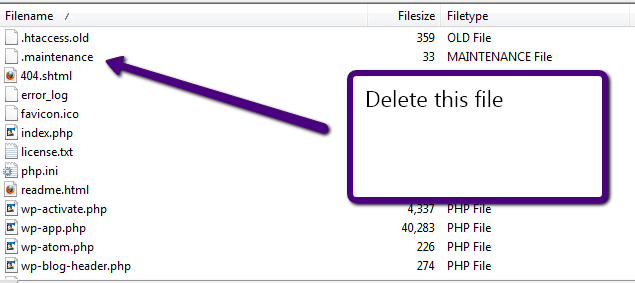
    Fortunately the fix is fairly simple, you need to attach to your site using ftp or with the file manager in your hosting account, and in the root of your installation you will see a file called .maintenance, simply delete this file and you site will come back to life.

    SPECIAL NOTE: files which start with a full stop/period are marked as hidden files on unix/linux, you may need to enable show hidden files on your FTP client before you can see this file, for example on filezilla you need to go to server->force show hidden files.

    If At First You Don’t Succeed

    Once you have deleted the .maintenance file it is a good idea to re-apply the updates you were doing to make sure they have been completed correctly.

  • Case Study: Migrating From WordPress.com

    Case Study: Migrating From WordPress.com

    In recent months I have been asked by a number of clients to migrate them from hosted WordPress.com sites to their own self hosted versions.

    This post is designed to talk you through that process and to point out any pitfalls.

    Why Move?

    Good questions, hosted WordPress takes all of the burden of supporting your site, applying updates, fighting with miss behaving plugins and the whole shebang. If you want a low overhead, no trouble site where you create content and publish I suggest you stay with wp.com.

    You only need to move to wordpress.org if you want the flexibility of your own themes, any plugins you want and ownership of your data.  (WP.com has been guilty of censoring any sites which don’t comply with their T & Cs).

    Themes

    You should have no problems keeping the look and feel of your site as most of the themes available on wp.com are available to download and install on wp.org.  Check the bottom of you site to get the theme name from the footer and search in http://wordpress.org/extend/themes/ for that theme.

    I say this with a small caveat, nearly all of the projects I have worked on required small tweaks on the theme to make them exactly the same, for some reason the code used on wp.,com is not the same as the downloadable version.  These are very minor typographic things usually, but my clients have noticed them immediately and asked for fixes.  Not a game stopper but a little annoying.

    Plugins

    WP.com limits the number of plugins available to you, and all of the plugins on .com are available to download from http://wordpress.org/extend/plugins/ and a whole lot more.  Don’t get too giddy .com’ers when you see how many new plugins are available to you :).

    Export/Import of Data

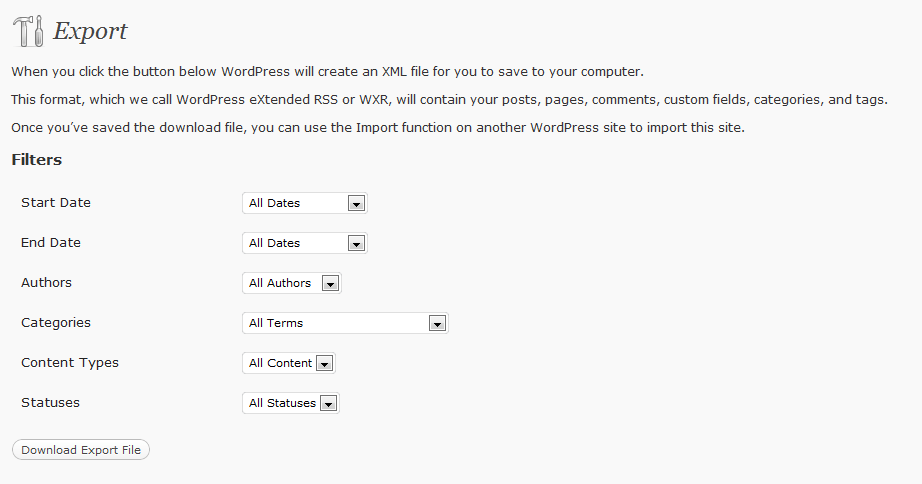
    WordPress has a built in export and import function.  Using the export function on your wp.com site you can greate an XML file which contains all of your posts, pages, categories, comments and tags in fact all of your user generated data.

    This is under the tools -> export function.

    You can export all of the data, or subsets on authors, dates, categories etc

    Click to see full size image


    Take this import file to your new wp.org site and run the import from tools->import.

    If it is a new site you will need to go through a process to install the importer, this is just like adding a plugin.

    During the install process there is an option to download and import any attachments, click on this to bring over any images / other content on your old site.

    Something to note, you can import wp.com data to an existing site so this can also be used as a tool to reconcile two sites.

    Things to watch; if you have a lot of data on your wp.com site and the export file is large, some hosting companies have a cap on the file upload size and you may need to make multiple exports using the export function, for example export two files of different date ranges.

    Redirection

    Once you have moved all of your data, the last thing to consider is a redirection to send all of your site traffic from wp.com to your new shiny.org site.

    This is much easier to do than it once was, WordPress have created an upgrade option for $12 to do this for you.  Purchase the update and setup the redirect to your new site.

    This is a 301 redirect so any listings in the search engine indexes will be updated with your new location.

    Wrap Up

    Moving to self hosted has been made deliberately simple, it is the obvious next step for bloggers as they become more confident with WordPress, follow this process and not much can go wrong.

    If you are still a little unsure of this process feel free to get a quote from my on my WordPress technical support page.

    Image by jmichaeltracy

  • WP Owner Club Webinar Replay

    WP Owner Club Webinar Replay

    Last week I ran a live webinar to re-launch my WordPress training program the WP Owners Club.

    If you were NOT able to attend the live event, I have uploaded a recording of the webinar at the following link.

    https://dev.neilmatthews.com/webinar-replay

    The replay will be available until Wednesday 16th March or until all 20 places on the course are filled so please take action now if you are interested in securing a place.

  • WP Owners Club Re-Opens Soon

    WP Owners Club Re-Opens Soon

    My WordPress training program the WP Owners club will be opening it’s doors to new members on March the 17th, and I would like to invite you to a free webinar to explain how my training works.

    “WP Owners Club Launch”

    Thursday 10th March  11-12am Pacific, 2-3pm Eastern and 7-8pm UK (duration 30-45 mins)

    It is no cost but lines are limited.

    https://www1.gotomeeting.com/register/763066081

    The session will be recorded, so even if you cannot attend teh live event, signup and I will send you the recording.

    What Is The WP Owners Club?

    It is a group coaching program designed to teach WordPress site owners more about the backend of their site.

    What’s In the Coaching?

    The coaching is comprised of six modules which run one per week for six weeks.  Here is a break down of the modules:

    Module One – WordPress Overview

    In this module I will give you an overview of the WordPress system, a tour of the dashboard and an introduction to the various layers that make up WordPress.

    Module Two – Content; Posts, Pages and Comments

    Learn all about the main content areas of your site posts, pages and comments, learn how to manage, create and use the tools available to you.

    Module Three – Understanding Themes

    Learn how to manage the look and feel of your site, learn all about the various types of theme available, how to install and customise your theme.

    Module Four – Plugins Masterclass

    Plugins allow you to extend the functionality of WordPress, in this module I will teach you how to source, install and manage your plugins.

    Module Five – Users and Roles

    You can have more than one user maintaining and adding content to your site, learn how to manage and control their access.

    Module Six – WordPress Maintenance

    There are various maintenance tasks that need to be done to all WordPress sites, learn how to update and keep your site running smoothly.

    Who Is The Coaching Aimed At?

    This coaching is aimed at people fairly new to WordPress who want to gain a more thorough understanding of how the back end of their sites works.

    How Is It Delivered

    The coaching is delivered via live weekly webinars where I will present the material and also show you live examples on my test WordPress site.

    The sessions will also be recorded and be made available to you to view again in a members only section of my site.  This means that if you miss anything in the live webinar you can review it again in your own time.

    Launch Webinar

    I’m inviting you to join a free launch webinar where I can show you how to coaching works, how much the course will cost, a look behind the scenes in the members area and a chance to answer any questions you may have on the WP Owners Club.

    Join my launch webinar

    Thursday 10th March  11-12am Pacific, 2-3pm Eastern and 7-8 UK (duration 30-45 mins)

    It is no cost but lines are limited, so reserve your place now  by  clicking on the link below:

    https://www1.gotomeeting.com/register/763066081

    The session will be recorded, so even if you cannot attend teh live event, signup and I will send you the recording.

    I look forward to seeing you on the webinar.

    Neil