Neil Matthews

Author: Neil Matthews

  • How I Automate Collecting Social Proof

    How I Automate Collecting Social Proof

    How I Automate Collecting Social Proof

    I’ve automated the way I collect social proof from a client I have completed a project with. I thought a post on how I automate collecting social proof may be of interest to you fellow online workers.

    What Is Social Proof

    Wikipedia has this to say about social proof:

    Social proof, a term coined by Robert Cialdini in his 1984 book, Influence, is also known as informational social influence. It describes a psychological and socialphenomenon wherein people copy the actions of others in an attempt to undertake behavior in a given situation.”

    I’ll not re-invent the wheel you can read the full article here social proof, I’ll wait here until you come back.

    My definition is a little less wordy, “Proof from real people to show potential clients you can do what you say you can do and that you are not mental to work with”.

    What Social Proof Do I Collect?

    I collect three types of social proof, case studies, testimonials and referrals.

    Testimonials

    These are self explanatory, I ask if people enjoyed working with me and can I have a small statement  on how working with me was, and the results we achieved together.

    Case Studies

    I don’t actual collect a case study, rather I solicit approval from my client that I can write up a case study for the project we have just worked on.

    If they say yes, then I write up a blog post on the project we have worked on and publish that on my site.

    Referrals

    I ask my clients if they know someone who would benefit from my services and for them to make an invite.  I have a form that sends a message to the new potential client making an invite.

    If someone recommends you to friends, colleagues or family, that is a high level of trust and great social proof.

    My Automated Process For Social Proof

    Here’s how I automate collection of the above types of social proof.

    I’ve got a password protected form hidden on my site that is pretty simple, it asks for the email address of the client and there is a check box that says case study.  This is the only part of the process I cannot automate because of the way projects work.  I complete the form once a project is complete and the magic happens.

    The form is connected to Mailchimp and it adds one of two tags to a clients profile.  Case study or social proof.  If the case study checkbox is selected then the tag is case study else it is social proof.

    Tags in mailchimp are pretty powerful, when a tag is added you can automatically add a person into an email sequence.  Let me walk you through those tags.

    When a person is added to the social proof tag, the email automation sequence looks like this:

    • Wait 3 days
    • Send email checking in on the project we have just completed and make sure there are no issues we have missed.  On all the emails I let people know it’s an automation, but a reply will come to “real Neil”.
    • Wait 7 days
    • Send an email asking for a testimonial on the project we have just worked on, this points them to a form they complete which automatically adds a new testimonial into my system as a draft, I review this and make it live.  The testimonial is added to this page.
    • Wait 23 Days
    • Send an email asking if they know anyone else that would be a good fit to work with me, invite the client to complete a form where I’ll send a message to the new potential client.  In exchange for this referral I give both current and potential client a discount on their next project.
    • Remove tag from client

    When a person is added to the case study they are added to an automation that looks like this.

    • Wait 3 days
    • Send email checking in on the project we have just completed and make sure there are no issues we have missed
    • Wait 3 days
    • Send an email saying this project was pretty unique and that I would like to write it up as a case study, is that okay with the client?  If they are okay with that I write up a case study
    • Wait 7 days
    • Send an email asking for a testimonial on the project we have just worked on, this points them to a form they complete which automatically adds a new testimonial into my system as a draft, I review this and make it live.
    • Wait 23 Days
    • Send an email asking if they know anyone else that would be a good fit to work with me, invite the client to complete a form where I’ll send a message to the new potential client.  In exchange for this referral I give both current and potential client a discount on their next project.
    • Remove tag from client

    Both types of tagged client are then moved into a 90 day recurring check in where I check to see if they need any help with their site.

    The Why Behind This Automation

    Why do I use this automation?  Two reasons, I’ll forget if I don;t automate it and I’ll not do it manually because I’m lay and always have too many other things to do.

    This automation is improving my marketing by getting new referrals and adding lots of juicy social proof to my site in the.

    Wrap Up – How I Automate Collecting Social Proof

    I recommend building a series of small automation in your business like these, they stream line your processes and make you look professional in the eyes of your clients.

    If you need help building these type of automation let me know, I’ll do the tech work required get in touch


    Doing the seo dance –  how I automate collecting social proof

     

  • Do You Need A Virtual CTO?

    Do You Need A Virtual CTO?

    Do You Need A Virtual CTO

    Do you need a Virtual CTO also know as a Virtual Chief Technology Officer?

    I’m offering a new consulting service that I’m calling the Virtual CTO package.  Let me tell you more about it.

    What Does A Virtual CTO Do?

    If you’ve worked with me in the past, you probably came to me with an IT issues you wanted me to fix.

    The Virtual CTO flips that on it;s head a little and I become an integral member of your team to build an IT strategy to deliver your business goals.

    You get access to my years of IT experience and knowledge to make IT work for your business.

    Why I Want To Be Your CTO.

    My favourite types of projects are consulting ones.  I’m called in with a problem to solve, I find a technology solution and implement that.

    Being your CTO is like a large ongoing consulting project where we have a series of business goals we need to achieve and lots of IT problems to solve.

    What We Will Do Together

    If you retain me as your virtual CTO we’ll do the following together …

    1) Create A Technology Strategy For Your Business

    We’ll get together in a virtual meeting a create a technology strategy to match your business goals.

    W’ll look at your business goals and we’ll create a plan to use technology to hit those business goals.

    I’ll document that and create an action plan.

    We’ll costs out the strategy to meet your budget, then the hard work begins.

    2) I’ll Implement That Strategy

    I’ll work to implement that strategy so we can hit your business goals together with tech.

    Some of the items I’ll do myself but we may need to outsource other aspects, but we’ll cross that bridge when we come to it.

    I’ll either do or manage the process to get our technology strategy full functional.

    3) Get Results

    The result of this ongoing consulting project is IT that works for your business.

    We can use IT to automate, streamline, scale and increase your bottom line.

    My Credentials To Be Your CTO

    I’ve worked in IT all of my career, that’s over twenty years.  I’ve spent a lot of time in large corporate IT departments before starting my own IT business.

    Here are some of the big corporate IT companies I’ve worked with PWC (Acconting), UK National Health Service, Nissan (Automotive), Santander (Banking), Aviva (Insurance).

    I’ve started my own IT company WPDude.com (as you probably know), more than 10 years ago.

    Here are some bullet points on my experience:

    • I’ve built websites (more than I care to remember)
    • I’ve built apps
    • I’ve built teams
    • I’ve outsourced work
    • I’ve built processes to make business run like clock work
    • I know how to market an online business
    • I know how to sell online
    • I can integrate across technologies
    • I can automate
    • I can program
    • I’ve built sales funnels
    • I’ve built ad campaigns
    • I’ve built lead magnets
    • and lots lots more …

    In short I can make IT work for your business.

    An Example

    Here’s a hypothetical example of what we could do together.

    You own an online e-commerce business that sells physical goods. We get together and create a strategy plan.  Your business goal is to increase sales from your WooCommerce store.

    We find that shipping is a bottleneck, that getting repeat business is an issue and cart abandonment is a problem.

    Our action plan looks like this:

    Outsource shipping to fulfilment by Amazon, implement extensions in WooCommerce to automatically send new orders to Amazon to send our from their warehouses for us.

    To get repeat business we implement an automated funnel in Mailchimp to reach out to current customers every 30 days with alerts about new products that we have that match the ones they have already purchased.

    We install tools that monitor for an alert to cart abandonment.  If a user adds an item to their cart and begins the checkout process and then abandons it we know about it.  We send an automated reminder to that person using WooCommerce extensions and Mailchimp.

    It will have details of their cart, and a nice 10% discount if they complete checkout, a single click brings them back to your store with their cart intact to checkout to increase sales.

    Who Is This For?

    This is for owners or CEOs of small online business that need help implementing an IT strategy.

    You are growing an online business but technology is getting away from you, you don’;t have time to know all the tech out there and don’t want to.  you don’t have time.

    You have money to invest in a team and technology but not the time to do it yourself.

    Your Investment

    If you hire me as your Virtual CTO it’s a monthly ongoing retainer model.  The minimum amount is five hours per month at my consulting rate of £50 per hour.  That’s £250 per month.

    If you want to get things done more quickly you can increase my retained hours.  If our strategy action plan calls for more work again you can increase that minimum.

    I have limited time available for this type of work, so I have opened up four Virtual CTO client slots.

    Limited Lifetime

    I don’t see this as a continuous engagement, rather we’ll build the strategy, implement it and there will be a natural end to the consulting and we’ll end the retainer.

    Application Process

    As mentioned I only have four two (slots are going quickly)  available slots for this type of work, so I have an application process, complete this form and tell me how I can help your business and we’ll book a call to start a conversation to see if I’m a good fit to  work with you as your Virtual CTO.

    Wrap Up – Do You Need A Virtual CTO

    I’m excited to work with people as their virtual CTO, if you need direction to get IT working for you get in touch.

    Apply for my Virtual CTO program.

    Photo Credit: ajmexico Flickr via Compfight cc

  • How To Customise Your WooCommerce Checkout Fields

    How To Customise Your WooCommerce Checkout Fields

    How To Customise Your WooCommerce Checkout Fields

    In this video I talk about how to customise your WooCommerce checkout fields.  These are the pieces of information collected on your WooCommerce checkout page.

    If like me you sell virtual products, all of the physical delivery details are not required and may add to cart abandonment.  I suggest you trim the fields that are not required on your checkout.

    Video Notes

    Past the following code in the theme functions file, go to appearance -> editor and open functions.php.

    You can remove some of the field exclusions if you want to keep them in

    add_filter( ‘woocommerce_checkout_fields’ , ‘nm_simplify_checkout_virtual’ );

    function nm_simplify_checkout_virtual( $fields ) {

    unset($fields[‘billing’][‘billing_company’]);
    unset($fields[‘billing’][‘billing_address_1’]);
    unset($fields[‘billing’][‘billing_address_2’]);
    unset($fields[‘billing’][‘billing_city’]);
    unset($fields[‘billing’][‘billing_postcode’]);
    unset($fields[‘billing’][‘billing_country’]);
    unset($fields[‘billing’][‘billing_state’]);
    unset($fields[‘billing’][‘billing_phone’]);
    add_filter( ‘woocommerce_enable_order_notes_field’, ‘__return_false’ );

    return $fields;
    }

    If you are a Wuss there is a plugin to do the same 🙂

    Flexible Checkout Fields for WooCommerce – WooCommerce Checkout Manager

    List of checkout fields

    Wrap Up – How To Customise Your WooCommerce Checkout Fields

    If you need help customizing your WooCommerce checkout please do get in touch.

    Doing the seo dance again how to customise your WooCommerce checkout fields.

    Photo Credit: Barta IV Flickr via Compfight cc

  • Automate Your WooCommerce Marketing With Mailchimp

    Automate Your WooCommerce Marketing With Mailchimp

    In this video post I show you how to automate your WooCommerce store marketing with Mailchimp.

    Do this work once to bring back customers to your WooCommerce store, up-sell more products and recover abandoned carts.

    Links in Video

    emilianofelicissimo Flickr via Compfight cc

  • Case Study: Password Protected Podcast

    Case Study: Password Protected Podcast

    In this video walk-through I’ll take you through a password protected podcast setup I created for a client in WordPress.

    The site is Qiological.com owned by Michael Max

    Plugins / Extensions Used

    Here is a list of the plugins / extensions used in this project.

    Photo Credit: seefit Flickr via Compfight cc

  • Give Away The What And Charge For The How To

    Give Away The What And Charge For The How To

    I’ve been using a marketing technique for many years, where I give away the “what” and charge for the “how to”. Using marketing content I’ll teach people the “what” and I’ll sell services or training to give the “how to”.

    Marketing content can be your blog posts, your YouTube videos or your free downloadable e-book.

    Then charge for the how to;  the technical implementation, details on how to do the “thing”.

    The “What” Shows You Are An Expert

    When you can articulate how something works with the “what” free content you are showing yourself as a subject matter expert.

    You can educate your audience that there is this “thing” and it may be useful to them in some way.


    The How To Makes The Denaro

    In the what phase you may show how to do the “thing”, but it might be too technical for many people, or people just don’t have the time to do it.

    Or, the how may be a new concept, people don’t understand yet, their appetite is whetted by the what and they choose to learn more.

    At this point, the person you marketed too for free can choose your premium option and pay for your services or premium products.

    EXAMPLE: Diary Mapping

    Here’s a real life example of this with my DiaryMapping.com course, which goes fully live today (what’s the chances of me writing this post on the day I go live, you can’t plan things like this).

    Diary Mapping brings in new potential students with a free Understanding Diary Mapping course and if they want to go deeper there is a premium How To Diary Map course for $9.00.

    The “What “For Free

    I’ve created a free course that brings the new concept of a diary map to people.

    I’m using this free “what” guide to introduce my concepts to people at no risk.  I’m explaining what Diary Mapping is, the terminology and how it can help people to tame their to-do list.

    If a potential student is interested they can move onto the how to, if it’s of no interest, no problem they can move onto the next thing in their day and ignore the premium course.

    The How To For A Fee

    I have a second premium course on the same site which goes much more deeply into the how to Diary Map subject.

    I explain how to build a diary map, how to control their to do list etc.

    The people who pay for this have been through the free “what” phase and have realised this is useful to them.

    It’s not too pushy and it gives a way to test what you have before anyone buys.

    Wrap up – Give Away The What And Charge For The How To

    Giving away the how and charging for the how to has worked for me in WordPress consulting jobs, Courses and other areas of my business.

    Give it a go, and remember to check out my free Understanding Diary Mapping course to see this process in action

  • Sometimes YOU Need To Be YOUR Own Client

    Sometimes YOU Need To Be YOUR Own Client

    Once you have been working as a client service Freelancer for some time, you reach a point where you have a full roster of clients and things are rolling along nicely.

    A byproduct of your success is that you get less and less time to work on your own internal projects.  In this post I want to suggest that sometimes you should be setting aside time for your internal projects as if you were your own client.

    “Work expands to fill the time available for its completion” – Parkinson’s Law

    Parkinson’s law says work expands to fit the time, if you don’t add your own work into that pile, your client work will expand to fill ALL of your time.

    You can tell when I have a lot on, blog posts don’t come out, and I don’t get to work on my own stuff.  This post explains how I’m planning to combat this.

    Sometimes you need to be your own client:

    Have A Deadline

    Step one to being your own client is a deadline.  Set a deadline and keep to it.

    This week I have half a day on Thursday to work on my own projects.  It’s booked out in my Weekly plan and my daily plan for today.

    Have Deliverables

    It’s tempting to say, I’ll do my marketing automation project (see below) in this “me as a client slot”, but that is too vague. Create real actionable items so the work gets done in the time you have available.

    I have three entries this morning

    1. Write “Sometimes YOU Need To Be YOUR Own Client” blog post, publish and promote.
    2. Create module 6 of Diary Mapping – write script, record, publish in Teachable
    3. Create module 7 of Diary Mapping – write script, record, publish in Teachable

    If I don’t get all of those done, I can roll them forward to “me as a client” slot next week.

    If I try to cram too many items into my project time I need to learn to drop some times.

    Keep To It

    The easiest thing in the world is to cancel your own project work, if client work runs over or you are running behind on tasks.

    Treat yourself as an annoying squeaky wheel client that is checking in and demanding work gets done.  Don’t put it off, get it done!

    “You” Projects Are Valuable & Important

    You’ve identified this work because it’s important to your business in the long term.

    Don’t teat that new client request that has just come in as a higher priority than you, schedule the new client project appropriately but don’t give it a higher priority than yourself.

    Me As A Client

    I have three things I want to do in Q1 2019 and I’m booking out time for them each week.  I’m doing it on a Thursday.

    Sometimes it may be half a day, sometimes a full day.  I want to do the following three things this quarter:

    1. Write a blog post each week
    2. Complete my Diary Mapping premium course
    3. Setup marketing automation for my WordPress consulting work.

    These are all action items from my annual planning session I did back in November.

    I’ve been setting up out of office notifications on my email to let people know I’m unavailable, and I will be slow to reply to them.

    Internal Guilt Trip

    I’ve been doing Thursday, with me as a client, throughout December and I have experience some internal resistance and guilt about this.

    My monkey brain is shouting “You should be working on client X’s project they are paying you!”.

    My rational mind needs to learn to quiet the monkey brain and tell it, “This is for the long term good, it’s only a few hours of your time, you can get to client X after lunch, you are beautiful, you are loved.”.

    Well perhaps not the last two, but you should not feel bad about working on your internal projects in parallel with client projects.

    That’s What Weekends & Evenings Are For Dude!

    .. I hear you cry, but I’m too exhausted by client work (which already pushes into my evenings) and my weekends are a time to recharge and do fun things.

    Why should my own projects be scheduled at sub-optimal times?

    Wrap Up

    I’m going to be using this technique to get my internal projects done this year.  Thursday is Neil time and it’s none negotiable :).

    Does anyone else have any particular techniques they use to ensure their own non-client facing work gets done, discussion in the comments please.

    Photo Credit: willbuckner Flickr via Compfight cc

    It’s a metaphor Dude! You create a parking slot in your weekly plan and you say No Parking to client projects in that slot.

  • Diary Mapping

    Diary Mapping

    Back in 2012 I was spinning lots of plates and a number of them were crashing down around my ankles.

    I was suffering from to-do overload and I realised I needed a new way to manage my to do list.

    I was and still am a huge fan of mind maps and I was wondering if I could merge that with the to-do list in my diary.

    2013 came around and I implemented a system I have come to call Diary Mapping.

    It’s a simple visual method of managing my to-do list. It;s analogue and manual and requires a thoughtful approach to task management.

    I’ve created a free overview course to give you an insight into my system, with a premium course to come.

    The free version is the what  and the premium version is the how to.

    Checkout out the introductory course at DiaryMapping.com

  • Freelancer Feast And Famine

    Freelancer Feast And Famine

    If you work for yourself, you will be well aware of the freelancer feast and famine cycle.

    You take on a project and get a payment.  You then do your thing, for your clients, and there is no further payment or new projects until you complete that piece of work.

    We get the feast a deposit payment and final payment then there is the famine phase where we get no more cash until the work is done.

    Here’s What It Looks like

    This is very much simplified and does not take into account reserves (but I’m all about the dramatic charts 🙂 )

    1. A project is approved and a deposit payment is taken.
    2. You work on the project
    3. At the same time as you are working, you are accruing expenses and your payment is being eroded.
    4. At the end of the project you get the final payment and hopefully your expenses have not exceeded your deposit payment.
    5. In the ideal world you have a new project in the pipeline and your final payment and a new deposit payment makes it bumper feast but that is not always the case.

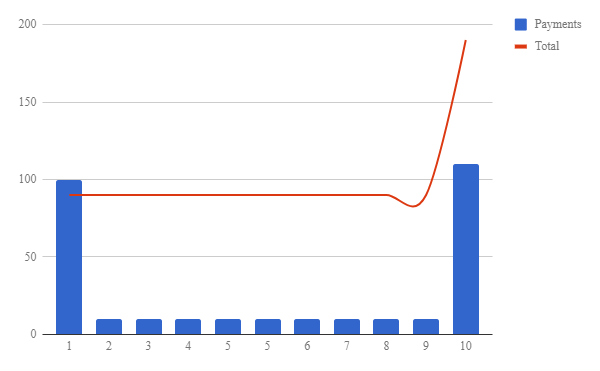
    Here’s the basic chart, $100 deposit, $10 expenses per day and a final payment of $100 after 10 days.

    This is a pretty precarious model.  If you over-run, before the project is complete you go negative.

    If you client is slow in paying the final payment, again you go negative.

    Here’s the same data but with a 5 day overrun or late payment.


    Smoothing The Freelancer Feast And Famine Cycle

    My idea of a µAgency helps to smooth the feast famine cycle by having lots of small µRetainers from my clients paying for a small service.

    What I suggest is you add a new recurring retainer to your existing client work and charge a large number of your clients, a small fee for a service they need on a recurring basis.

    In my case I provide an ongoing maintenance plan for my clients where they get backups, updates and fix on fail if things break on their site.

    I have a lot of clients on that plan paying me a small fee each month, add that to my project work income, and my income chart looks different to the ones above.

    I cannot do a lot of this work as I’m booked out on projects so I have a team member delivering this service.

    If I add in $10 of retainers each day, the graph looks much different.

    freelancer feast and famine

    You can see the retainers have flattened the curve significantly and the final payment on the project puts us into profit,

    My thinking is that you should have enough small of µRetainers to cover your “nut” or your basic monthly income costs, then all project work you do on top of that is just a bonus.

    If Only There Was A Course About µAgency!

    Well slap my thighs and call me Rodger, if I haven’t already built a course to do that.

    The stars must be aligning, the teacher appears when the student is ready!

    I’m building two courses on the µAgency:

    Understanding the µAgency – this is a free course to help you understand the what of a µAgency.

    Build Your Own µAgency – this is the how to, so you can create your own small firm.  This will costs £99 and is under construction and will be released in the next few weeks.

    Both courses are available at my new site https://MicroAgencySchool.com

    The transformation these courses are designed to give you, is one from solo freelancer to agency owner in a control and managed fashion.  I’ll lead you past the pit falls that befell me when trying to build an agency.

    Wrap Up – Freelancer Feast And Famine

    I’m going to bang on about the µAgency for a few more posts, apologies if this is not your thing.  Normal programming will return shortly.

    I’ve looked long and hard for training on how to take the first step from online solopreneur to agency owner and believe me, they are few and far between, and NONE take you through the first initial steps like I am.  That’s why I’m doing this.

    Check out my free training over at https://MicroAgencySchool.com.

    Photo Credit: devinlynnx Flickr via Compfight cc

  • Attack Of The Clone

    Attack Of The Clone

    Several years back, I had an amazing idea.  If I could find a clone of myself, I could double the income coming into my business.  This was when my business suffered the attack of the clone.

    How hard could it be ..

    The Back Story

    I was booked solid.  I had a full roster of stand alone projects.  I had about 50 maintenance clients demanding my attention.

    I realised it was time for me to move from being a freelancer to running a firm.  If I could find someone with my skill set I could bring in even more projects, load up my maintenance plans and roll naked in pound notes.

    Recruiting Locally

    I started my search locally looking for a clone of myself to help in my business.

    I’m not cheap (you need to buy me a beer and a steak dinner first) and I found recruiting a clone of me is even more expensive. On top of salary  I would have to incorporate (UK sole traders cannot employ staff), I would need to make pension contributions, national insurance employer payments and bring a whole pile of grief and accountant bullshit (sorry my accountancy clients but your forms and terms make my head spin) into my life, hell no!

    The few people I know with my level of WordPress skills laughed when I tried to recruit them, why would they join a startup agency when they could work at big agencies or run their own very successful freelance businesses.

    I Had To Go Offshore

    I looked offshore to recruit remote contractors.

    I tried India, Tim Ferris tells us India is the way, I’ll not go into details here, but there is a cultural norm with Indian techies that makes them hard to work with, in my experience.

    I went to South East Asia and the Philippines. I very quickly had a team of three people working with me.

    I was bringing in more money, more clients and more stress for myself with a full client workload and a new unexpected job managing a team and ensuring sales were at a level to cover my additional costs.

    Then the sh1t hit the fan and cash flow dried up and I was not earning enough cash to pay my team and myself so they were all let go.

    Time goes by, rinse and repeat I recruited another team.

    Then the sh1t hit the fan and an unexpectedly large tax bill forced me to let go of my team.  I did not have the cash flow in place to cover this unexpected expense and pay their invoices.

    Time goes by, rinse and repeat I recruited another team ….

    I had three failed attempts at building an agency. The attack of the clone became the attack of the clone x3.

    Back To the drawing board

    I went back to being the solopreneur.

    It was fine for a while but I had more maintenance clients and just as much project work. Very quickly I was full fit to bust with work again.

    I knew I needed help but I also knew I could not clone myself and try to build an agency again.

    I took myself off and had some deep thinking time, that’s where I formulated the idea of a µAgency.

    I Now Run A µAgency

    I wrote a post outlining my ideas about a µAgency last year I’ll wait while you check that post out.

    I’ve built a micro agency where I concentrate on the one off projects and have a single team member to run my maintenance plan.

    It works really well, I have a recurring income steam that takes very little of my personal time to run and I have a lot more time to take care of my one off projects.

    I can take time off my business and still earn an income.

    I have a µAgency business that is resilient because it has lots of small µRetainers bringing in income each month.

    I’ve decided to share how to build a micro agency with other freelancers.

    Who Is A µAgency For?

    It’s for solo freelancers looking to make the leap from freelancer to firm.

    It’s for freelancers taking the first step (or even their only step) to building a firm.

    I want to show freelancers how to take baby steps and build an agency that will work and not break due to cash flow issue or other unexpected issues.

    I want to show freelancers how to build a tiny agency that will not consume them with management time.

    I want to show freelancers how to build a recurring income that does not take their time.

    I want to show freelancers how that can take time off from work and still have money coming in.

    From Freelancer To Firm

    I’ve built a new site called MicroAgencySchool.com where there are courses to teach you how to build a µAgency.

    There is a free introduction course which teaches you what a µAgency is and a premium course launching later this year to show you how to build that agency step by step.

    From freelancer to firm is the tag line I’m using with my courses.  That’s the transformation I’m trying to help you make.  I want to show you how to move from being a solopreneur to a tiny agency owner without making the mistakes I did.

    I’m Not A Guru

    In the post I talk about not being a guru but I’m passionate about helping people grow their online business so I’ve created a these courses to help people understand what a µAgency is.

    Wrap Up – Attack Of The Clone

    Let me be Yoda to your Luke Skywalker and show you how to build a micro agency.  Check out my free course over at the MicroAgencySchool.com

    If you like what you see, you can check out the premium course which will step you though building your own µAgency coming later this year.

    Photo Credit: Zellaby Flickr via Compfight cc

    doing the seo dance – attack of the clone

  • Keeping Up With The eJoneses

    Keeping Up With The eJoneses

    I’ve got a bit of an issue, I’m always keeping up with the eJoneses.

    What do I mean by that?  I’m always looking at other peoples online business and comparing it to mine and trying to compete or copy what they are doing.

    Let me tell you ladies and gentlemen this is a route to ruin and unhappiness.  I say sod the eJoneses and build a business you love!

    Other Peoples Businesses

    We peek over the virtual white picket fence and see other people with X employees, product Y, Service Z and think we need to do that to keep up with them.

    We never stop to think are X, Y and Z a good fit for me? We never stop to think is this just the latest shiny object?

    Derek Sivers said in his excellent little book Anything You Want .

    When you make a company, you make a utopia,  It’s where you design your perfect world.

    I highlight your because when you are a solopreneur, you are building something that is great for you, not someone else, not a board of directors or share holders and it’s definitely not for Mr Jones down the .com street.

    Build A Business YOU Love

    I’ve talked about this in the past but we are in a unique period in history where we don’t had to grimly plod down to the dark satanic mills and work for the landed gentry anymore.  We don’t need oppressive jobs, we can strike out on our own.

    If you have a little chutzpah we can build our own online freelance business that is a perfect  fit for you.

    Some Examples Of Keeping Up With The eJonses

    Here are some examples of my trying to keep up with other peoples business ideals.

    wpcurve – I saw this amazing business boom and eventually exit to Godaddy, I can build a business like that at wpdude.com I thought, but I don’t like managment, managing people sucks, I want the right sized business a µAgency of me plus another person to cover maintenance work. I don’t want to build a big team.  I tried but hated it, and wpdude.com has been sunset and NeilMatthews.co has risen.

    dropshipping – this is the new kid on the block, find products that can be sourced from manufactures in China, set up an Amazon of shopify store and sell those good. Have the manufacturer deliver them and make money while you sleep, gave it a go, made a few quid, boring as hell, why would I want to spend time on that?

    App Development – I still think this has legs, but I was losing focus on my key WordPress consulting business to focus on building apps as well, it had to go (for now anyway).

    Not To Do List

    I have a way to combat trying to keep up with the eJoneses, and that is my not to do list.

    I have a highly coloured mind map on my wall right in my eye-line and is has my not to do items on it, here’s the list.

    • App development
    • Build an agency (I’ve spent a lot of time building a multi person agency that I hated working in )
    • Buy any new domain names (sound familiar to anyone 🙂 )
    • Focus on selling my business
    • Jump between ideas
    • Go off plan (I make a plan each November)
    • Spend time on tools (I can spend a lot of time messing with new tools / software)
    • Low end productized services (I was trying to create something like wpfixit.com)

    If I’m going off piste I look at my not to do list and bring myself back on course.

    Wrap Up – Keeping Up With the eJoneses

    Build the business you want, not the one you think you need because someone else is doing it that way.

    Have fun building your business and don’t be afraid to pivot away from a product or service that you don’t enjoy delivering or creating.

    Just because Ms Jones has 100 clients does not mean you need 100 clients, 20 of them may be douche nozzles and need to be sacked.

    Build a business YOU love.

    I’ll be writing a lot more about small business in the lead up to the launch of my new course Micro Agency School.

    How have you been guilty of keeping up with the eJoneses, comments below please.

    Photo Credit: kuyabic Flickr via Compfight cc

    Doing the seo dance – Keeping Up With The eJoneses

  • WordPress Is Not The Only Game In Town

    WordPress Is Not The Only Game In Town

    I’m going to be black balled from the Guild of WPers when I publish this post, but here we go anyway! WordPress is not the only game in town, sometimes WordPress is not the best tool for every project {sharp intake of breath from the audience}.

    If there is a pre-made website solution for a particular project you are planning, then please look into that before you try and build a custom solution from WordPress plugins and a theme.

    WordPress is of course open source and free but any complex problem you are trying to solve probably needs some custom plugins and a decent looking theme and that’s not free.

    Don’t get me wrong I’m a huge fan of WordPress and I’ve based my business around it but I have found certain situations pre-made single solutions software as a service is better.  Here are some examples:

    Training – If you are looking to create a members only training site, there are plugins out there but they are pretty complex and expensive. There are software solutions to create your training business (more later).

    Helpdesk – the plugins out there are not that great, and require a lot of setup, it’s far easier to assign a custom domain to Helpscout.

    E-Commerce – I’ve talked about my love/hate relationship with  WooCommerce in Why I’m Breaking Up With WooCommerce if you want a simple robust e-commerce site look to Shopify, I built a test drop shipping store in a few hours.

    CRM / Project Management – this is an area that plugin developers have not touched in my experience Basecamp and the rest do a better job.

    .com vs .org – WordPress itself has two versions, if you want a simple blogging solution look to WordPress.com rather than creating a custom site with WordPress.org.

    Case Study – A Course Website

    I’m build a course to expand upon my idea of a µAgency, the free introduction course will be coming out soon and the paid version a little later this year. I was looking into the best plugins to use for a learning management system or LMS.

    Here are my requirements:

    • Protected course material (video)
    • Student registration
    • Payment gateway
    • Email Integration to up sell courses and keep in contact with students
    • Responsive out of the box
    • User only forums for questions about content
    • Integrates with Freshbooks so my accounts are done automatically
    • Nice to have – affiliate program so students can refer me and earn a fee.

    WordPress solution

    For a WordPress solution I would need:

    • Custom theme $50,
    • Learndash plugin $150 (learn dash has zapier integration for Freshbooks)
    • Private video subscription with Vimeo $100 per annum,
    • wp affiliate plugin $99 per annum

    So the total cost to build this site per year would be about $400 plus my time to bring all these disparate systems together and build the site.

    While searching for LMS plugins I saw some ads for Teachable.com a single solution website builder, I decided to investigate.

    Teachable solution

    For a teachable solution I would need:

    • 1 subscription to teachable $39/month

    All of my requirements are built in plus some additional item such as author sharing, automatic affiliate payments.

    Teachable is designed out of the box to sell courses. That’s all it does it has design back end features I need.

    I signed up for a free account and my site was built, I added a few stock photos and voila a “school” in their terms to sell courses, it looks good has lots of great features and will enable me to build my course with ease.

    They host my videos securely, manage students have back end email facilities, affiliates with auto payments, they handle refunds and payments through their system and give me a monthly payout.

    The have zapier integration so I can add invoices to my system to automate my accounts.

    Neil is a happy chappy, site built in about an hour, custom domain assigned.  My course structure is built I just need to drop in my videos.

    I’m busy creating my content once that is done I’ll sign up for a premium subscription at $39 per month or  $468 per annum, so the price is similar but the effort was way less.  That payment is monthly rather than a large up front payment for plugins.  One sale per month will pay for this project.

    Wrap Up – WordPress Is Not The Only Game In Town

    Choose the best tool for the job, if you need a hole in a wall choose a drill if you need to dig a hole it’s a spade.

    WordPress will do the job, but sometimes the effort outweighs results. I love WordPress and I’ll always provide WordPress technical support, but sometimes I tell my clients no, use this instead.

    MicroAgencySchool.com will be opening it’s doors soon. I could have built it with Learndash but the quickest route to market is Teachable. I’m using the correct tool!

    Are there any single solution website builders you prefer over WordPress? Discussion in the comments below.

    Photo Credit: grahamsholt Flickr via Compfight cc