Lorem ipsum dolor sit amet, consectetur adipiscing elit. Morbi sagittis, sem quis lacinia faucibus, orci ipsum gravida tortor, vel interdum mi sapien ut justo. Nulla varius consequat magna, id molestie ipsum volutpat quis. Suspendisse consectetur fringilla suctus. Pellentesque ipsum erat, facilisis ut venenatis eu, sodales vel dolor.
Morbi sagittis, sem quis lacinia faucibus, orci ipsum gravida tortor, vel interdum mi sapien ut justo. Nulla varius consequat magna, id molestie ipsum volutpat quis. Suspendisse consectetur fringilla luctus. Fusce id mi diam, non ornare orci. Pellentesque ipsum erat, facilisis ut venenatis eu, sodales vel dolor.
This is a unorder list. Lorem ipsum dolor sit amet, consectetur adipiscing elit. Morbi sagittis, sem quis lacinia faucibus, orci ipsum gravida tortor, vel interdum mi sapien ut justo.
Nulla varius consequat magna, id molestie ipsum volutpat quis. Suspendisse consectetur fringilla luctus.
Fusce id mi diam, non ornare orci. Pellentesque ipsum erat, facilisis ut venenatis eu, sodales vel dolor.
Lorem ipsum dolor sit amet, consectetur adipiscing elit. Morbi sagittis, sem quis lacinia faucibus, orci ipsum gravida tortor, vel interdum mi sapien ut justo. Nulla varius consequat magna, id molestie ipsum volutpat quis. Suspendisse consectetur fringilla luctus. Fusce id mi diam, non ornare orci. Pellentesque ipsum erat, facilisis ut venenatis eu, sodales vel dolor.
Morbi sagittis, sem quis lacinia faucibus, orci ipsum gravida tortor, vel interdum mi sapien ut justo. Nulla varius consequat magna, id molestie ipsum volutpat quis. Suspendisse consectetur fringilla luctus. Fusce id mi diam, non ornare orci. Pellentesque ipsum erat, facilisis ut venenatis eu, sodales vel dolor.
Expanding your website’s reach across multiple languages is a strategic move to tap into global markets and reach a diverse audience. However, for multilingual websites to succeed in the competitive online landscape, effective Search Engine Optimization (SEO) strategies are essential. If your website is powered by WordPress and WPML (WordPress Multilingual Plugin), you’re already on the right track. In this blog post, we’ll explore how you can leverage WPML to optimize your multilingual website for search engines and improve visibility across different language markets.
1. Choose a SEO-Friendly URL Structure
When setting up your multilingual website with WPML, consider the URL structure carefully. WPML offers several options for structuring URLs, including subdomains, subdirectories, or separate domains for each language. Choose a structure that’s SEO-friendly and helps search engines understand the language targeting of each page.
2. Implement hreflang Tags
Hreflang tags are crucial for signaling to search engines the language and regional targeting of your content. WPML automatically generates hreflang tags for each language version of your pages, ensuring proper indexing and ranking in relevant search results. Verify the accuracy of hreflang tags using Google Search Console to avoid potential errors.
3. Optimize Meta Tags and Content
Each language version of your website should have unique meta tags, including titles, descriptions, and keywords, optimized for relevant keywords in that language. WPML allows you to easily customize meta tags for each language version directly from the WordPress editor. Additionally, ensure that your content is translated accurately and naturally, maintaining high quality and relevance across all languages.
4. Submit Language-Specific Sitemaps
Create separate XML sitemaps for each language version of your website and submit them to search engines through Google Search Console or Bing Webmaster Tools. WPML simplifies the process of generating language-specific sitemaps, making it easy to ensure that all pages are indexed correctly.
5. Monitor and Analyze Performance
Regularly monitor the performance of your multilingual website using tools like Google Analytics and Google Search Console. Track key metrics such as organic traffic, keyword rankings, and user engagement across different language versions. Analyze data to identify opportunities for optimization and refine your SEO strategy accordingly.
6. Leverage Local SEO Strategies
Tailor your SEO efforts to specific language markets by implementing local SEO strategies. This includes optimizing content for local keywords, obtaining backlinks from relevant local websites, and ensuring consistency in NAP (Name, Address, Phone Number) information across all language versions of your website.
Conclusion
Optimizing a multilingual website for search engines requires careful attention to detail and a solid understanding of SEO best practices. With WPML, you have a powerful tool at your disposal to streamline the process and ensure that each language version of your website ranks effectively in relevant search results. By following the tips outlined in this guide and staying proactive in your SEO efforts, you can maximize the visibility and reach of your multilingual website, driving organic traffic and achieving success in global markets.
In the competitive landscape of e-commerce, providing a seamless and personalized user experience is paramount. For businesses operating multilingual websites powered by WordPress and WPML (WordPress Multilingual Plugin), catering to users’ language preferences can significantly enhance engagement and conversions. One effective way to achieve this is by automatically redirecting visitors to language-specific pages based on their browser language settings. In this blog post, we’ll explore how you can implement this feature using WPML, ensuring that your website speaks your visitors’ language from the moment they arrive.
Understanding the Importance of Language Redirection
Imagine a scenario where a visitor lands on your website but is greeted with content in a language they don’t understand. Such a situation can lead to frustration and a high bounce rate. By automatically redirecting users to the appropriate language version of your website, you can eliminate this barrier and provide a more tailored experience, increasing the likelihood of engagement and conversion.
Implementing Language Redirection with WPML
WPML offers a convenient solution for redirecting visitors to language-specific pages based on their browser language settings. Follow these steps to implement language redirection effectively:
Install and Activate WPML: If you haven’t already, install and activate the WPML plugin on your WordPress website. You’ll need the Multilingual CMS version or higher to access the language redirection feature.
Enable Browser Language Redirection: In your WordPress dashboard, navigate to WPML > Languages. Under the ‘Browser Language Redirect’ section, enable the option to ‘Redirect visitors based on browser language.’
Configure Language Priorities: Set the language priorities to specify which languages should take precedence when redirecting visitors. WPML will automatically detect the visitor’s browser language and redirect them to the corresponding language version of your website.
Customize Redirection Behavior (Optional): WPML provides additional customization options, allowing you to define fallback languages and specify whether to redirect users only on their first visit or on every visit.
Testing and Optimization
After implementing language redirection, it’s crucial to thoroughly test its functionality to ensure a smooth user experience. Here are some tips for testing and optimization:
Browser Compatibility: Test the redirection feature across different browsers to ensure compatibility.
Fallback Options: Verify that fallback languages are configured correctly in case the visitor’s preferred language is not available.
Performance Monitoring: Monitor website analytics to assess the impact of language redirection on user engagement, bounce rate, and conversions.
Conclusion
By automatically redirecting visitors to language-specific pages based on their browser language settings, you can create a more user-friendly and personalized experience for your website’s international audience. With WPML’s built-in redirection feature, implementing this functionality is straightforward and hassle-free. Take advantage of this powerful tool to break down language barriers and better connect with your global audience, ultimately driving engagement and boosting conversions on your WordPress website.
If you need help building a multi language site, please get in touch.
In today’s interconnected world, e-commerce businesses are increasingly looking to expand their reach beyond borders. One effective strategy to tap into international markets is by creating a multilingual WooCommerce store with support for multiple currencies. In this blog post, we’ll explore how you can achieve this using WPML (WordPress Multilingual Plugin) for language translation and delve into the intricacies of setting up multi-currency support to provide a seamless shopping experience for customers worldwide.
Step 1: Installing WPML for Multilingual Support
WPML is a powerful plugin that simplifies the process of creating a multilingual WordPress site, including WooCommerce stores. Here’s how you can get started:
Install WPML: Navigate to your WordPress dashboard, go to Plugins > Add New, search for “WPML,” and install the plugin.
Activate WPML: Once installed, activate the plugin and follow the setup wizard to configure your primary language and additional languages.
Translate Content: With WPML activated, you can now translate your product pages, categories, and other content into multiple languages. WPML provides an intuitive interface for managing translations efficiently.
Step 2: Configuring Multi-Currency Support
While WPML handles language translation, integrating multi-currency support requires an additional plugin. One popular option is the WooCommerce Multilingual plugin, which seamlessly integrates with WPML to provide multi-currency functionality. Here’s how to set it up:
Install WooCommerce Multilingual: Similar to WPML, install the WooCommerce Multilingual plugin from the WordPress repository and activate it.
Configure Currency Settings: In your WordPress dashboard, navigate to WooCommerce > WooCommerce Multilingual > Multi-Currency. Here, you can enable multi-currency support and configure currency options.
Set Exchange Rates: WooCommerce Multilingual allows you to set manual exchange rates or use automatic exchange rate updates from services like Open Exchange Rates or CurrencyLayer.
Customize Currency Switcher: Customize the currency switcher widget to match your store’s design preferences. You can choose between dropdowns, flags, or inline converters.
Step 3: Testing and Optimization
Once you’ve set up multilingual and multi-currency support, it’s essential to thoroughly test your store to ensure everything works as expected. Here are some tips for optimization:
User Experience: Test the language switcher and currency converter to ensure they function smoothly on all devices and browsers.
SEO Optimization: Optimize your store for multilingual SEO by providing translated meta tags, URLs, and content.
Localized Content: Tailor your product descriptions, promotions, and marketing materials to resonate with your target audience in different regions.
Conclusion
Creating a multilingual WooCommerce store with multi-currency support opens up a world of opportunities for e-commerce businesses seeking to expand globally. With WPML for language translation and WooCommerce Multilingual for multi-currency functionality, you can provide a localized shopping experience that caters to customers’ language and currency preferences. Follow the steps outlined in this guide to unlock the full potential of your online store and reach new markets with ease.
If you need help creating a multi lingual woocommerce store get in touch.
Are you looking to expand your WooCommerce store’s reach to international markets? One of the essential features to consider is providing currency conversion capabilities. This allows customers from around the globe to view product prices in their preferred currency, enhancing user experience and potentially boosting sales. Fortunately, integrating a currency converter into your WooCommerce store is easier than you might think, thanks to a variety of plugins available. In this post, we’ll explore some of the top currency converter plugins for WooCommerce.
1. WooCommerce Currency Switcher by WP Wham
This versatile plugin allows your customers to switch between different currencies seamlessly. It automatically detects the user’s location and sets the currency accordingly, but users can also manually select their preferred currency from a dropdown menu. Additionally, it offers real-time exchange rates, ensuring that your prices are always up to date.
If you’re looking for a lightweight solution, the Currency Converter Widget might be the perfect fit for your WooCommerce store. This plugin adds a simple currency converter widget to your site, allowing users to quickly convert prices without leaving the page. It supports multiple currencies and is highly customizable to match your store’s design.
WOOCS is a feature-rich currency switcher plugin that offers extensive customization options. It supports over 200 currencies and allows you to set custom exchange rates if needed. The plugin also provides various display options, including dropdowns, flags, and inline converters, giving you full control over how currencies are presented to your customers.
WooCommerce Multi-Currency is another powerful plugin that simplifies the process of adding currency conversion to your store. It automatically detects the user’s location and selects the appropriate currency, but users can also manually choose their preferred currency. The plugin supports both automatic and manual exchange rate updates and offers compatibility with popular payment gateways.
5. Currency Switcher for WooCommerce by PluginUs.NET
This user-friendly plugin allows you to add a currency switcher to your WooCommerce store with minimal setup required. It offers automatic currency detection based on the user’s IP address and supports over 170 currencies. The plugin is highly customizable, allowing you to configure currency symbols, exchange rates, and more to suit your store’s needs.
Adding a currency converter to your WooCommerce store is a simple yet effective way to cater to international customers and improve their shopping experience. With the plugins mentioned above, you can seamlessly integrate currency conversion functionality into your store, helping you reach a broader audience and increase sales. So why wait? Choose the plugin that best fits your needs and start expanding your WooCommerce store’s global reach today!
If you need help making your woocommerce store multi currency or multi language please get in touch.
Introduction LoginWP Plugin The WordPress login screen serves as the gateway to your website’s backend, making it the first interaction point for administrators, editors, and users. While WordPress offers a functional default login screen, customizing it to align with your brand identity or improve security can significantly enhance the user experience. Enter LoginWP – a powerful plugin designed to revolutionize your WordPress login screen. In this guide, we’ll explore the features and benefits of LoginWP and how it can transform the login experience for your website.
Introducing LoginWP: LoginWP is a feature-rich WordPress plugin that empowers website owners to customize every aspect of the login screen effortlessly. Whether you’re looking to add branding elements, enhance security measures, or improve user engagement, LoginWP offers a comprehensive suite of tools to achieve your goals. Let’s delve into some of its key features:
Branding and Customization: LoginWP allows you to infuse your brand identity into the WordPress login screen effortlessly. With intuitive customization options, you can upload a custom logo, choose background images or colors, and tweak the login form’s appearance to match your website’s aesthetics seamlessly. By creating a cohesive login experience, you reinforce your brand’s presence and leave a lasting impression on users.
Custom Login URLs: Enhance security and deter unauthorized access by customizing your login URL with LoginWP. By default, WordPress login URLs follow a predictable pattern (example.com/wp-admin), making them susceptible to brute force attacks. With LoginWP, you can obscure the login URL with a unique slug, adding an extra layer of protection to your website.
Social Login Integration: Simplify the login process for users and encourage engagement by integrating social login options with LoginWP. By enabling social login buttons for popular platforms like Facebook, Google, Twitter, and more, you provide users with a convenient alternative to traditional username and password authentication. This not only reduces friction during the login process but also encourages users to interact with your website more frequently.
Custom Error Messages and Redirects: Tailor the user experience further by customizing error messages and login redirects with LoginWP. Instead of displaying generic error messages, you can provide personalized feedback to users, guiding them through the login process effectively. Additionally, you can set up custom redirects based on user roles, ensuring a seamless transition to the desired destination post-login.
Multisite Compatibility: For WordPress Multisite installations, LoginWP seamlessly integrates with the network administration interface, allowing super administrators to manage login screen customization across all sites within the network. This centralized approach ensures consistency and coherence in branding and user experience across multiple sites.
Conclusion: LoginWP is a game-changer for WordPress website owners seeking to elevate their login experience. Whether you’re a blogger, business owner, or developer, LoginWP offers a versatile set of tools to customize and enhance the WordPress login screen effortlessly. From branding and customization to security and user engagement, LoginWP empowers you to create a login experience that reflects your brand identity and fosters a positive user interaction.
Download LoginWP today and unlock the potential to transform your WordPress login screen:
With LoginWP, your WordPress login screen becomes more than just a gateway – it becomes a reflection of your brand’s identity and a seamless entry point for users into your website’s world.
Trigger warning, this blog post is a little dark and talks about death and what happens to your digital stuff after you are gone.
One of my clients sadly died recently. Invoices were going unpaid, emails were being bounced. I only learned about his passing when an obituary was placed on the site I was maintaining for him. I’m guessing no-one knew I maintained his site for him.
This has caused some introspection on my part, and has made me ask the question, what will happen to my digital estate when I finally die?
The answer was a little bit worrying, my wife doesn’t know details of my Stripe account, she doesn’t know who my customers are or what I do for them. She doesn’t have any contact details for my team and how to keep the recurring income from my maintenance plans moving forward. This could be a valuable passive income stream for her and my kids.
I have a feeling that my digital assets will just wither away or even be a liability (services being paid for but not delivered).
What can I do to make sure these assets are passed to her via my digital estate.
First of all, let’s define what an estate is:
Everything owned by a person who has died is known as their estate. The estate may be made up of: money, both cash and money in a bank or building society account. This could include money paid out on a life insurance policy. money owed to the person who has died.
Real estate, stock and share, money in the bank or possessions are things traditionally classed as your estate, but we have a series of new things that I am calling my digital estate, while these are virtual they still have value.
Those of us building online businesses are creating digital assets that a) Have value and b) can be passed on in our estate.
Here are some of things I’ve been thinking about as I write this blog post:
Websites
Email lists
Payment providers accounts (Stripe/Paypal etc)
Client/Customer lists
Contractor details
Suppliers
Social media accounts
Email accounts
Domain names
Access to my SaaS accounts (Trello, Freshbooks and Managewp)
What Am I Going To Do?
So I’m going to write up a document and keep it with my will. I’m going to think about the things that have value and how she can keep them or dispose of them as she needs (or my kids need if she goes first).
I’m going to detail all the “digital things” I have with any monetary value. I’m thinking about areas of my business that have recurring income value and how they can keep working without me, I already have my maintenance plan largely running without me, can it run without me permanently and be passed on as an asset for example.
I’m going to write up how these assets can be sold or retained for a recurring income.
I’m going to document how to recover access to all these accounts, for example I found this to recover a google account.
I’m going to include in that document any debts I have, recurring invoices for software, how to pay the contractors I use.
And then finally we’ll have to sit down and go through this, that will be a fun session won’t it.
Wrap Up
That went dark pretty quickly didn’t it. Do you have a plan in place for your digital assets?
I study stoic philosophy and one of their ideas is Momento Mori, remember you will die or my favourite translation remember you have to die, it’s the process of meditating on your own mortality. It’s a good thing not a macabre thing.
If we think about our own mortality it helps us to put things into perspective, why am I worrying about that trivial thing when in the greater scheme of things it really won’t matter.
“You could leave life right now.Let that determine what you do and say and think.”
Introduction – Customizing the WordPress Login Screen The WordPress login screen serves as the gateway to your website’s backend, providing access to administrators, editors, contributors, and subscribers. While its default appearance is functional, customizing the login screen can add a touch of professionalism, reinforce your brand identity, and enhance the user experience. In this guide, we’ll explore various ways to customize the WordPress login screen, from simple tweaks to advanced modifications, using plugins that simplify the process.
Customize with LoginPress: LoginPress is a powerful plugin that allows you to customize every aspect of the WordPress login screen with ease. From changing the background image and colors to adding custom logos and text, LoginPress offers a user-friendly interface for personalizing the login experience.
Key features of LoginPress include:
Background customization: Choose from pre-designed backgrounds or upload your own images to create a unique login screen.
Logo and branding: Replace the default WordPress logo with your brand logo and customize the login form’s appearance to match your site’s aesthetics.
Text and messaging: Modify the login form’s text, labels, and error messages to align with your brand voice and tone.
Login form styling: Adjust the size, color, and typography of the login form fields and buttons for a cohesive look.
Enhance Security with Two-Factor Authentication: While customizing the login screen’s appearance is important, prioritizing security is equally crucial. Two-factor authentication (2FA) adds an extra layer of protection by requiring users to verify their identity using a second factor, such as a one-time code sent to their mobile device.
Key features of a 2FA plugin like Two Factor Authentication:
Increased security: Protect your site from unauthorized access by requiring users to verify their identity with a second factor.
Multiple authentication methods: Choose from various 2FA methods, including SMS, email, authenticator apps, or hardware tokens.
User-friendly setup: Implementing 2FA is straightforward for users, with clear instructions provided during the setup process.
Compatibility: Most 2FA plugins are compatible with popular login customization plugins, ensuring seamless integration with your customized login screen.
Add Social Login Options with Nextend Social Login: Streamline the login process for users by offering social login options alongside the traditional username and password fields. Nextend Social Login integrates with popular social media platforms like Facebook, Google, and Twitter, allowing users to log in quickly using their existing accounts.
Key features of Nextend Social Login:
Seamless integration: Add social login buttons to the WordPress login screen without requiring users to create new accounts.
Customization options: Customize the appearance and placement of social login buttons to match your site’s design.
User data synchronization: Automatically sync user profile data from social media accounts to WordPress, simplifying account management for users.
Enhanced user experience: Improve user engagement and conversion rates by reducing login friction and offering a convenient login alternative.
Conclusion: Customizing the WordPress login screen is an effective way to enhance your site’s branding, security, and user experience. With plugins like LoginPress, Two Factor Authentication, and Nextend Social Login, you can personalize the login process to align with your brand identity, strengthen security measures, and streamline user interactions. Whether you’re a blogger, e-commerce store owner, or corporate website administrator, investing in login screen customization plugins can elevate your site’s professionalism and leave a lasting impression on visitors.
Introduction – Understanding WordPress User Roles WordPress, being one of the most popular content management systems globally, empowers millions of websites across various niches. Central to its functionality is the concept of user roles, which determine the level of access and permissions granted to individuals interacting with the site. In this guide, we’ll delve into the various user roles in WordPress—Administrator, Editor, Contributor, and Subscriber—and understand their respective roles and responsibilities.
Administrator: The Administrator is the most powerful user role in WordPress, with complete control over all aspects of the site. Administrators have the authority to manage users, install and activate plugins, edit themes, modify settings, publish or delete content, and perform any other administrative tasks. They essentially have unrestricted access to the site’s backend and can make changes that affect its entire functionality. It’s crucial to limit the number of administrators to trusted individuals to maintain security.
Responsibilities of an Administrator:
Managing user accounts: Creating, editing, or deleting user accounts and assigning roles.
Installing and managing plugins and themes.
Configuring site settings: Adjusting general settings, reading settings, permalinks, etc.
Publishing and managing content: Creating, editing, and deleting pages, posts, and custom post types.
Handling site security: Implementing security measures and monitoring user activities.
Editor: Editors have significant control over content management on a WordPress site. They can publish, edit, and delete posts and pages created by any user, including other editors. However, they do not have access to administrative functions like plugin installation or theme customization. Editors are ideal for managing content workflows, ensuring quality, and maintaining consistency across the site.
Responsibilities of an Editor:
Reviewing and editing content: Ensuring accuracy, consistency, and adherence to style guidelines.
Publishing content: Approving and scheduling posts and pages for publication.
Managing categories and tags: Organizing content for improved navigation and SEO.
Monitoring user-generated content: Moderating comments and user submissions.
Contributor: Contributors have limited capabilities compared to administrators and editors. They can create and edit their own posts but cannot publish them directly. Instead, their submissions are subject to review and approval by editors or administrators. This role is suitable for guest authors, freelance writers, or individuals who contribute occasional content to the site.
Responsibilities of a Contributor:
Creating content: Drafting posts and submitting them for review.
Editing own content: Making revisions to submitted posts based on feedback.
Collaborating with editors: Communicating feedback and suggestions for improvement.
Subscriber: Subscribers have the most restricted role on a WordPress site. They can log in, edit their profiles, and leave comments on posts, but they cannot create or modify content. Subscribers are typically users who want to receive updates from the site or engage in discussions through comments.
Responsibilities of a Subscriber:
Managing profile: Updating personal information, including email address and display name.
Engaging with content: Reading posts and leaving comments on published content.
Conclusion: Understanding the various user roles in WordPress is essential for effective site management and user access control. By assigning appropriate roles to individuals based on their responsibilities and privileges, site owners can streamline workflows, maintain security, and ensure a seamless user experience. Whether you’re an administrator, editor, contributor, or subscriber, each role plays a vital role in contributing to the success of a WordPress site.
Introduction – User Role Editor Plugin Managing user roles and permissions efficiently is essential for any WordPress website owner. Whether you run a personal blog, an e-commerce store, or a corporate website, controlling who can access what features and content is crucial for security and organization. Fortunately, with the right tools, such as the User Role Editor plugin, WordPress users can easily customize and manage user roles and permissions to fit their specific needs.
What is User Role Editor Plugin? User Role Editor is a powerful WordPress plugin that empowers site administrators to manage user roles and capabilities with ease. It provides a user-friendly interface for customizing default user roles, creating new roles, and assigning or revoking capabilities for each role.
Key Features:
Role Management: User Role Editor allows administrators to modify existing user roles or create new ones from scratch. This feature is particularly useful for tailoring roles to match the unique requirements of your website.
Capability Assignment: With User Role Editor, you can finely tune the permissions granted to each user role by assigning or revoking specific capabilities. This granular control ensures that users have access only to the features they need, reducing the risk of unauthorized actions.
Role Duplication: Rather than creating new roles from scratch, User Role Editor enables you to duplicate existing roles and make necessary modifications. This feature saves time and ensures consistency across different user groups.
Content Protection: By restricting access to certain content based on user roles, User Role Editor helps you protect sensitive information and control who can view or modify specific pages, posts, or custom post types.
Multisite Support: For WordPress Multisite installations, User Role Editor seamlessly integrates with the network administration interface, allowing super administrators to manage user roles across all sites within the network.
How to Use User Role Editor:
Install and Activate: Begin by installing the User Role Editor plugin from the WordPress plugin repository. Once activated, navigate to the “Users” menu in your WordPress dashboard and select “User Role Editor.”
Customize Roles: From the User Role Editor interface, you can customize existing roles or create new ones by specifying a name and selecting capabilities from a comprehensive list. After making your adjustments, save your changes to apply the modifications.
Assign Roles: After defining your custom roles, you can assign them to users from the WordPress Users screen. Simply edit a user profile, select the appropriate role from the dropdown menu, and save your changes.
Fine-Tune Permissions: To further refine permissions, use the capability management feature to assign or revoke specific capabilities for each role. This level of control ensures that users have precisely the access they require.
Conclusion: User Role Editor is an indispensable tool for WordPress site administrators seeking to manage user roles and permissions effectively. With its intuitive interface and powerful features, this plugin simplifies the process of customizing roles, assigning permissions, and protecting content. Whether you’re running a small blog or a complex multisite network, User Role Editor empowers you to maintain control over user access and enhance the security of your WordPress website.
Enhance your WordPress experience by installing User Role Editor today!
Malware was injected into my site this week, it’s fine I’ve removed it and everything is fine, I just thought I would write a cautionary blog post to explain what happened and to show getting hacked can happen to anyone, even a so called WordPress developer.
You need to have tools in place to monitor for and react to malware injections. I offer this as part of my maintenance plan.
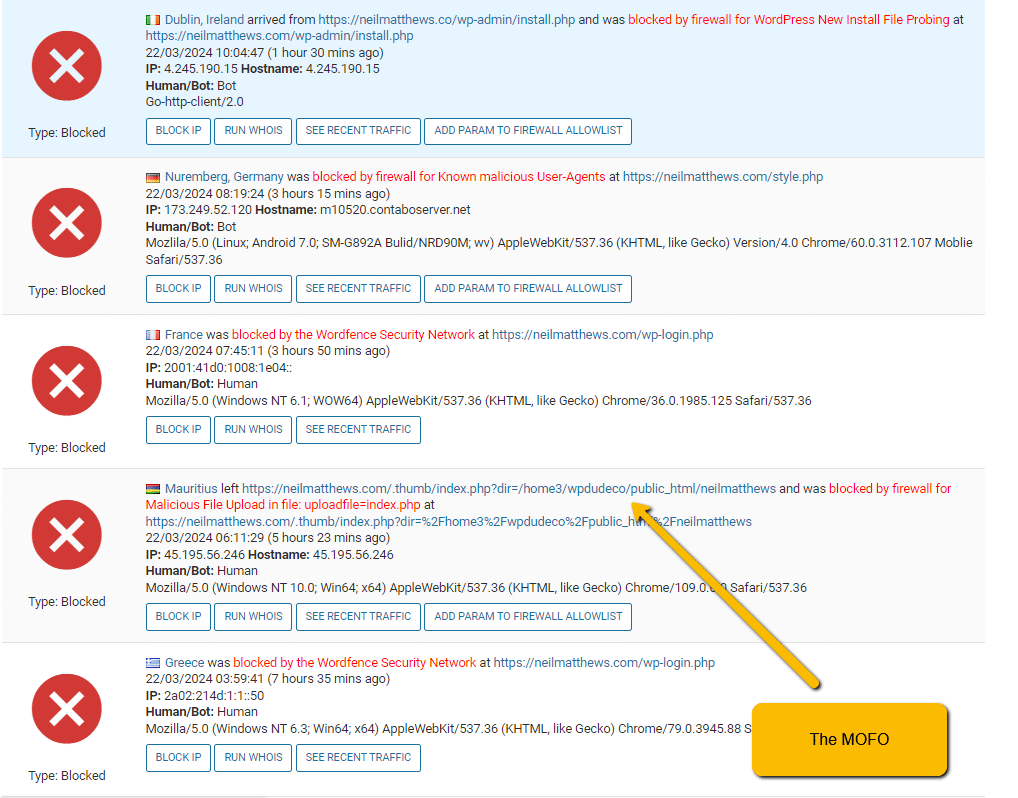
I was planning to write my weekly post and I was getting a lot of weird errors, I started working on the usual trouble shooting issues to find out what was wrong, and I noticed a weird directory called .thumb scattered throughout my site. Then I realised my index.php has malware injected into it.
Shite, I’ve been hacked!
A Deactivated Plugin Was At The Root Of The Problem
At the root of the problem is a plugin that was on my site called Memberpress. I’m not using this plugin, it’s deactivated and it does not have a license so no updates are being applied. That’s why it was vulnerable.
Even a plugin that is not active can still be called and code injected.
Thanks My Hacking Friend From Mauritius
I checked my logs and it looks like someone from Mauritius did the deed on me and injected the malware, I went to Cloudflare and added a firewall rule to block all people visiting my site from Mauritius.
This may seem like a nuclear option, blocking all people from a country, but I’ve never had a client from Mauritius so it was the easiest route to keep the hacker at bay. I’ve done the same for China and Russia before due to problems like this.
Was I Personally Targeted?
No, they scanned my site and probably hundreds of others for the know weakness, stumbled across my site and opened the door I left unlocked. Install Wordfence the security plugin and see how many blocked attempts your site gets. It’s quiet alarming how often your site gets tested, see this screen dump, that’s just a couple of hours.
They didn’t do anything malicious, they just injected code for fun I think. They did that because they could, that’s motivation enough for some people.
I added My Own Site To My Maintenance Plan
Once I realised I had been hacked I added my own site into my own maintenance plan. Why am I not doing that already you ask? Well as usual I’m so busy looking after other people site’s my own site is always relegated to second place. A rookie mistake.
A scan showed up a vulnerability in the plugin mentioned above straight away, if I was doing proper monitoring of my site this would have been spotted sooner and fixed.
Remember kids, do what I say not what I do :).
Site Clean UP
I patched the vulnerability, cleaned up my site and blocked countries access.
Wrap UP
Our sites are constantly being scanned for weaknesses but hackers, can I suggest you do what I did and sign up for my ongoing maintenance plan where I’ll monitor for and react to any security weaknesses on your site.
This is not the first time this has happened and I’m sure it won’t be the last, make sure you monitor your site for security issues.
Introduction – Adding a Wishlist to Your WooCommerce Store
In the competitive landscape of e-commerce, enhancing the shopping experience for customers is paramount. One effective way to delight your customers and encourage repeat purchases is by incorporating a wishlist feature into your WooCommerce store. A wishlist allows users to save products they’re interested in for future reference, making it easier for them to keep track of items they love. In this blog post, we’ll explore the benefits of adding a wishlist to your WooCommerce store and how you can do it effortlessly using plugins.
The Value of a Wishlist
A wishlist serves as a virtual shopping cart for customers to bookmark products they’re considering purchasing. Here’s why it’s a valuable addition to your WooCommerce store:
Enhanced User Experience: Providing a wishlist feature enables customers to curate their shopping preferences and revisit them conveniently at any time, fostering engagement and loyalty.
Increased Sales Potential: Wishlist functionality encourages customers to return to your store to complete their purchases, leading to higher conversion rates and revenue generation.
Insight into Customer Preferences: Analyzing wishlist data provides valuable insights into customer preferences and trends, allowing you to tailor your product offerings and marketing strategies accordingly.
How to Add a Wishlist to Your WooCommerce Store
Adding a wishlist feature to your WooCommerce store is straightforward, thanks to dedicated plugins. Here’s how you can do it:
Choose a Wishlist Plugin: There are several plugins available for integrating a wishlist into your WooCommerce store. Some popular options include:
YITH WooCommerce Wishlist: A feature-rich plugin that allows customers to create and manage multiple wishlists, share wishlists with friends, and receive email notifications about wishlist activity.
WooCommerce Wishlist: Developed by WooCommerce, this plugin seamlessly integrates with your store and offers customizable wishlist buttons and pages.
TI WooCommerce Wishlist: A lightweight yet powerful plugin that enables users to add products to their wishlist without needing to log in.
Install and Activate the Plugin: Choose the wishlist plugin that best suits your store’s needs, install it via your WordPress dashboard, and activate it.
Customize Settings (Optional): Depending on the plugin you’ve chosen, you may have the option to customize wishlist settings such as button styles, placement, and user permissions.
Add Wishlist Functionality to Product Pages: Once the plugin is activated, wishlist functionality will typically be automatically added to your product pages. Customers can then click a button to add products to their wishlist.
Display Wishlist Page: Most wishlist plugins create a dedicated page where users can view and manage their wishlists. Make sure to link to this page from your site’s navigation or footer menu for easy access.
Conclusion
Adding a wishlist feature to your WooCommerce store is a simple yet effective way to enhance the shopping experience for your customers and drive sales. By enabling users to save and revisit their favorite products, you can foster engagement, increase customer satisfaction, and gain valuable insights into their preferences. With a wide range of wishlist plugins available, you can easily find one that suits your store’s specific needs and customization preferences.
Ready to take your WooCommerce store to the next level? Explore the options mentioned in this post and start delighting your customers with wishlist functionality today!
If you need help setting up a wish list for your WooCommerce store get in touch.